Resident voices
Reddit communities (r/smarthome, r/homeassistant, r/HomeKit, r/googlehome, r/dubai) and the SmartThings and Home Assistant forums.
One agent and one super app for AI-native homes in the UAE, from the broker’s tablet to the bathroom mirror. A home that is right without being asked, and easy to correct when it isn’t.
Read the case study ↓Today’s smart home apps are remote controls with a grid of tiles. The resident does all the thinking.
A UAE developer is building AI-native homes and workplaces, with a lab, an Experience Centre and thousands of units on the way. The brief asked for one product that spans pre-sales, onboarding, handover and daily living, across chat, voice, a 3D avatar and touch, on many devices.
I treated it as a self-initiated concept to show how I would lead it: the developer, brand and data are fictional, the research is real. I wrote the requirements, the prioritisation model, the release roadmap and the team design, then designed the interaction language and the screens.
My point of view: invert the app. The first screen is not “your devices” but “what your home is doing for you right now, and why”, with one tap to undo. Control becomes the exception; explanation becomes the interface.
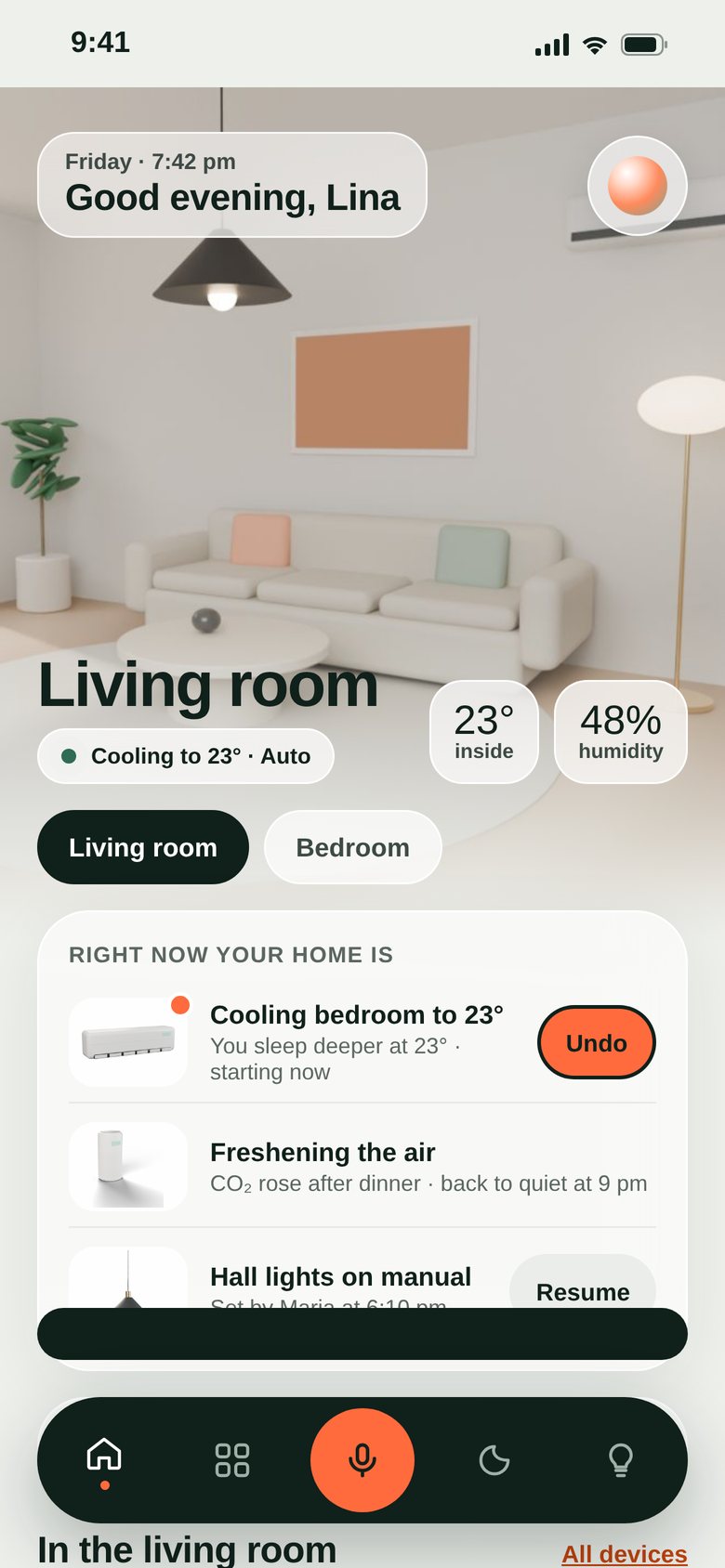
The Now screen: a photo of your own room, what the home is doing right now, and undo.
Qualitative sources told us why people love or abandon a smart home; the survey told us how common each pattern is in the UAE. Every finding became a principle and a set of requirements.
Reddit communities (r/smarthome, r/homeassistant, r/HomeKit, r/googlehome, r/dubai) and the SmartThings and Home Assistant forums.
Emaar One, Live Aldar, My Nakheel, Arada, e& Smart Living, plus local coverage of AI homes and district cooling.
Google Home with Gemini, Alexa+, Apple Home, Home Assistant, Josh.ai, Delos, Eight Sleep, Oura and Whoop.
A quantitative survey of UAE residents to size what we heard: habits, pain points, surfaces and comfort with AI acting at home.
One in five respondents is Emirati; the rest are a mix of the nationalities that live and buy in the UAE. Households with extended family, children and live-in helpers were part of the sample, because the household, not the owner, is the real user.
Families accept a smart home until it is unreliable or complex. One owner runs 200+ automations; his family doesn’t notice most of them, and that is the goal.
So: invisible when right, never wrong in front of the family.
A sunrise automation woke a child after a bad night; the parent had to wake the person who built it.
So: per-person context, one-tap pause, “why did this happen?”
Guests, parents and house-sitters use the wall, not the app.
So: the wall switch is a primary surface.
No tutorial, no app download for visitors. Keep the wow subtle.
So: guest and helper modes with zero onboarding.
Reviewers timed new AI assistants at up to 15 seconds for a simple command, with broken routines and wrong rooms.
So: a deterministic fast path; the LLM only where it adds value.
The October 2025 cloud outage stopped cloud-only homes; local homes kept working.
So: local-first core; the home works offline.
Every device still wants its own app for setup and full features.
So: one app, one agent; the developer owns integration.
Daily sleep scores can make people sleep worse (“orthosomnia”).
So: act on the room; weekly trends, no daily score.
Net Promoter Score by device category, US consumers
Sakan’s bar is a phone-level +44, not a speaker-level +13. Source: Parks Associates, 2025.
Average store rating, App Store vs Google Play, November 2026
Stars hide the problem: almost every app sits at 4.5–4.7 on the App Store. The signal is in what detractors write, so Sakan tracks its own in-app NPS instead of store stars.
| App | App Store | Google Play |
|---|
Coded from low-star reviews of 11 apps (Google Home, Alexa, SmartThings, Philips Hue, Home Assistant, Tuya, Aqara, Xiaomi, Govee, Emaar One, Live Aldar) and the Reddit threads.
Number of the 11 reviewed apps whose low-star reviews raise each issue
Reliability and speed top the list, which is why they ship first. Coded from App Store and Google Play reviews, November 2026.
Local-first hub, a developer-commissioned network, self-healing diagnostics
Under 300 ms local fast path; the switch never waits on the app
No silent removals; plain-word release notes; lab homes get updates first
The Now screen as home; settings in one place per room
Control, safety and privacy are never behind a subscription
Every action by touch and text as well as voice; screen readers; full Arabic
On-device processing, consent per person, data stays in the UAE
Every request has an owner, an ETA and updates; the agent never guesses
Proto-personas from the research. Each household role sets what the agent can see, do and say about that person.
WantsProof the “AI home” is real
FearsPaying for a gimmick; two years with no news
Broker tablet · PWAWantsA home that never surprises the kids or guests
FearsThe AC doing odd things at night, not knowing why
Switch · mirror · voice · PWAWantsDeep control, routines, data export
FearsLock-in, outages, an assistant that makes things up
PWA · chat · voiceWantsSimple controls in her language; her room is hers
FearsBeing monitored; blamed when tech fails
Wall switch · limited PWAWantsLights and AC that work like normal switches
FearsTalking to a machine; being confused
Wall switch · mirror glanceMeasure success by interactions avoided. If someone has to open the app, ask why.
Lights, AC, blinds and locks answer in under 300 ms from a local layer. The LLM never sits between a person and a light.
Every automatic action leaves a trace: what changed, why, and a one-tap override the agent learns from.
A physical control always works, always wins and never needs the network.
Wellness is cooler sleep and softer evening light, not scores.
Biometrics stay off until each person opts in, and each person can see and delete what the home knows.
Seconds from command to light on
Sakan: p95 target for the local fast path. Assistant: the slowest simple commands reviewers timed on new LLM-based assistants.
Up to 50×
faster than the slowest assistants, because the language model is never in the light-switch loop. It plans, explains and answers questions; local rules flip the switch.
Eight first-screen ideas in eight minutes, the five ambient states, the fast path, the surfaces and the information architecture, sketched before any screen was drawn.
From the sketches to the real thing: seven everyday moments, each designed on the device where it actually happens. Warm glass over photos of your own rooms and the things in them. Lights glow when they’re on and fade to grey when they’re off, so you can see what’s happening before you read a word.
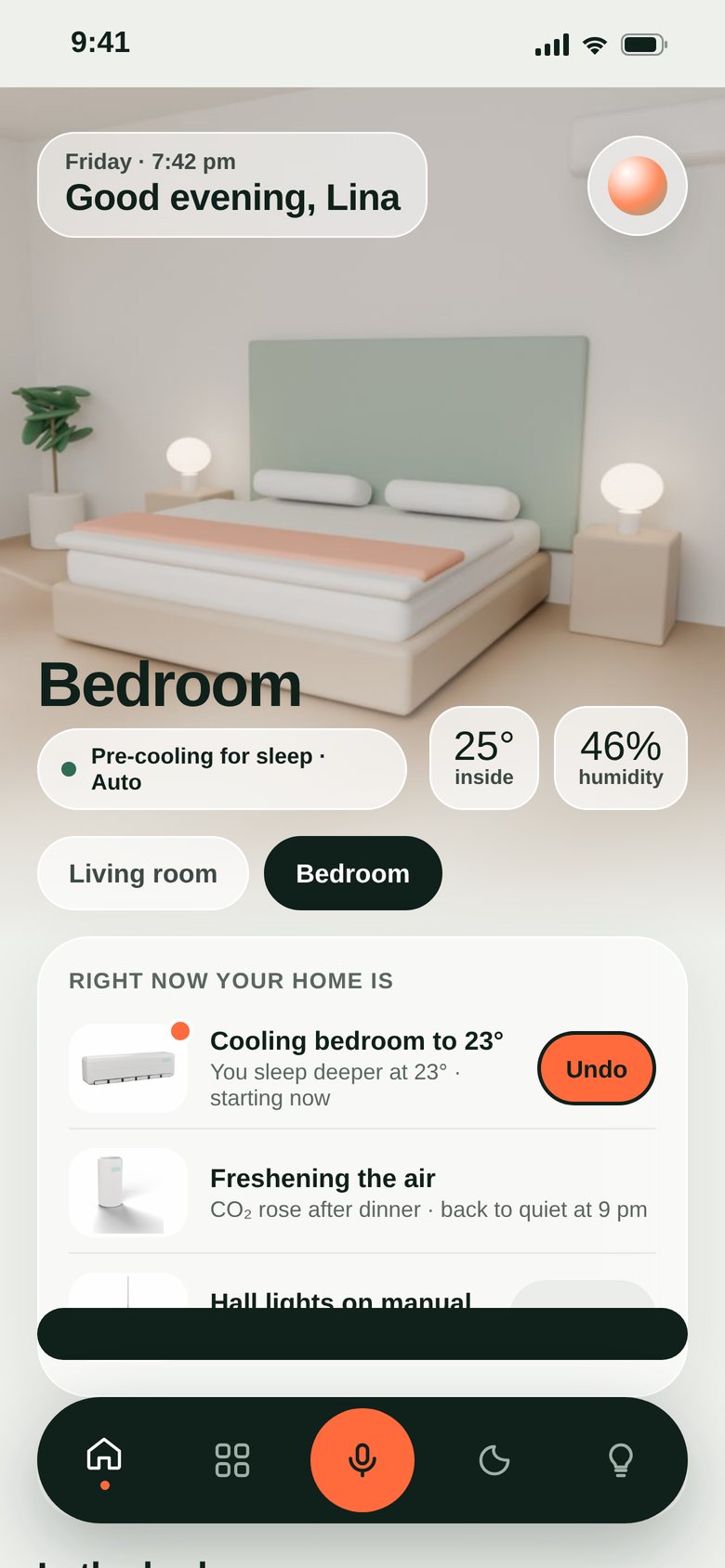
Lina walks in. The first screen is not a grid of switches: it’s her own living room, what the home is doing right now and why, and a ten-second undo on anything it just changed.
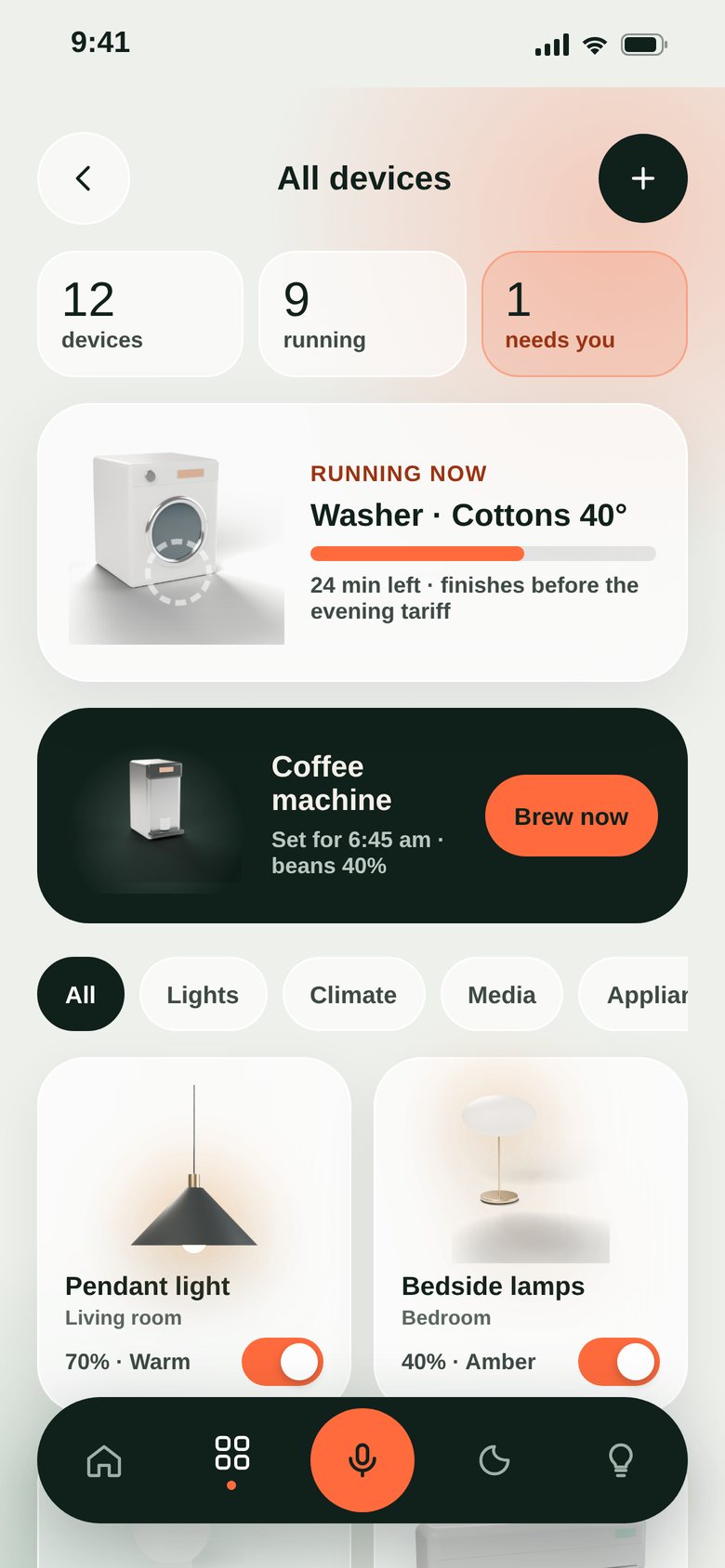
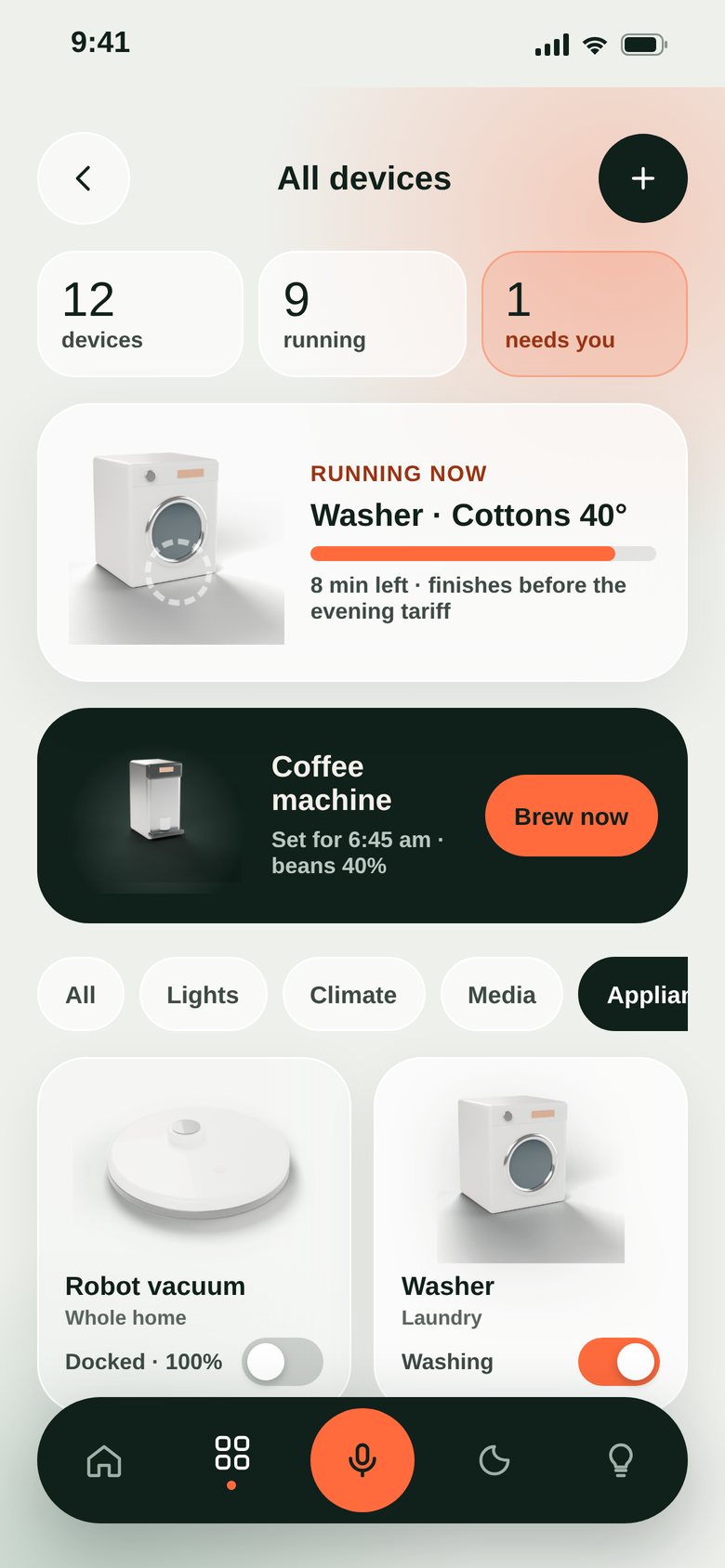
The washer, the coffee machine, the robot vacuum and the front door, each shown as itself. What’s running comes first, with time left and the reason it was scheduled.
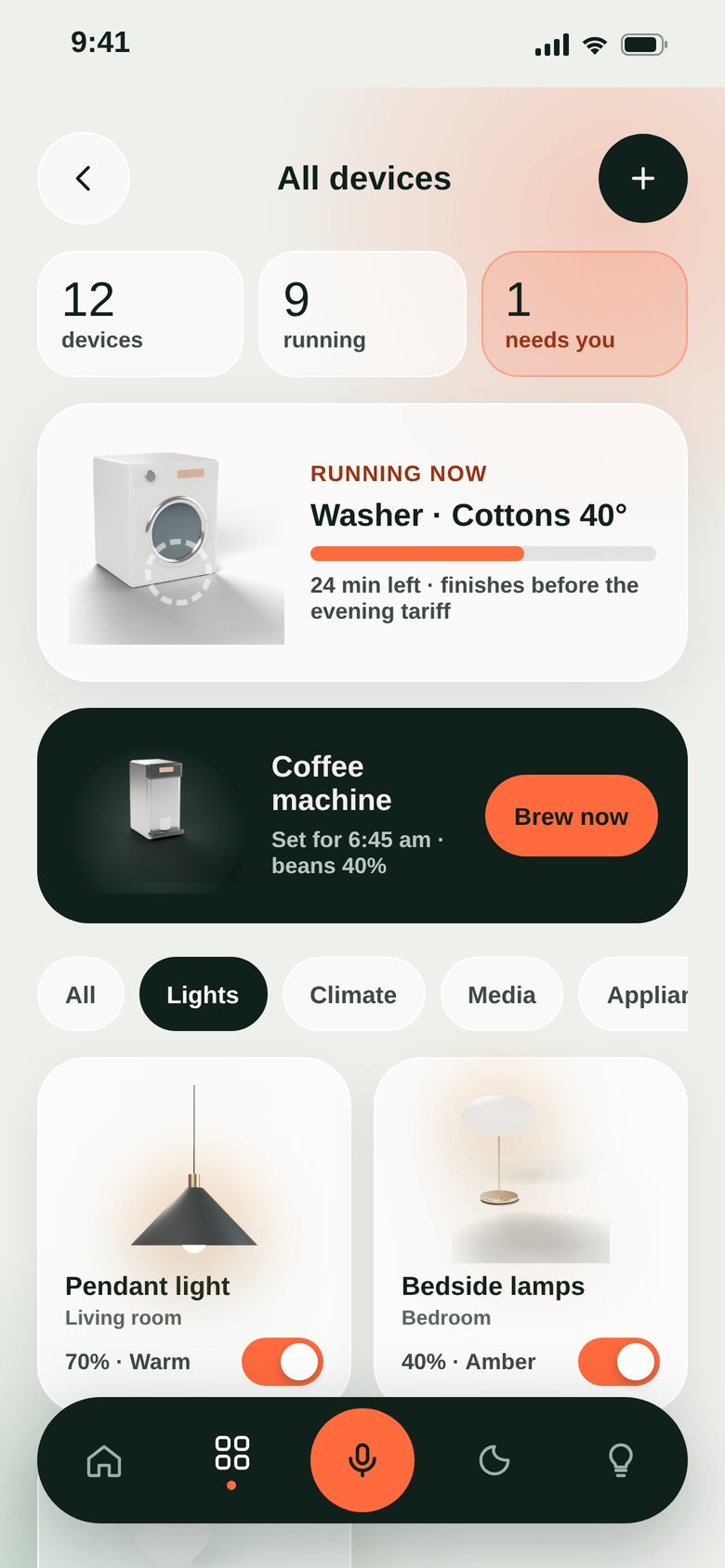
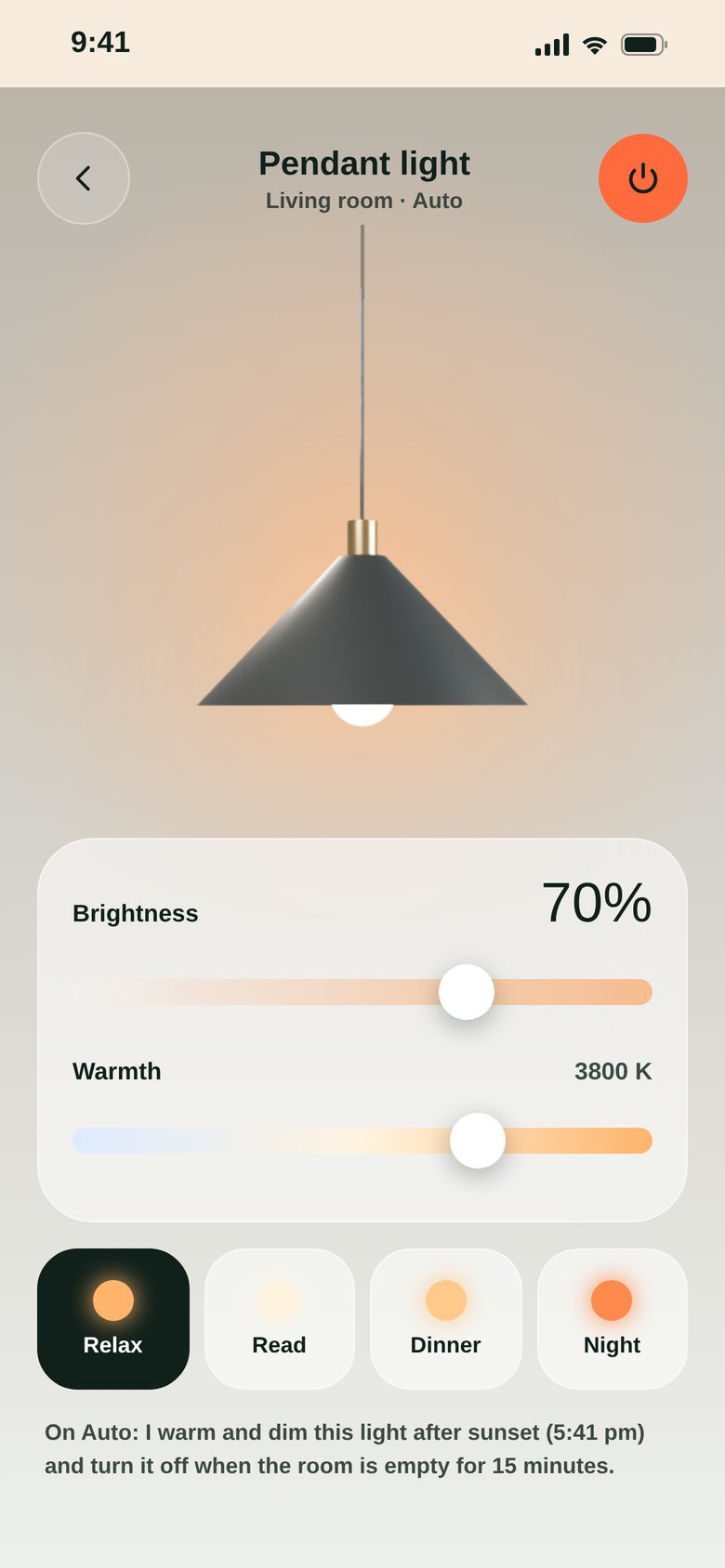
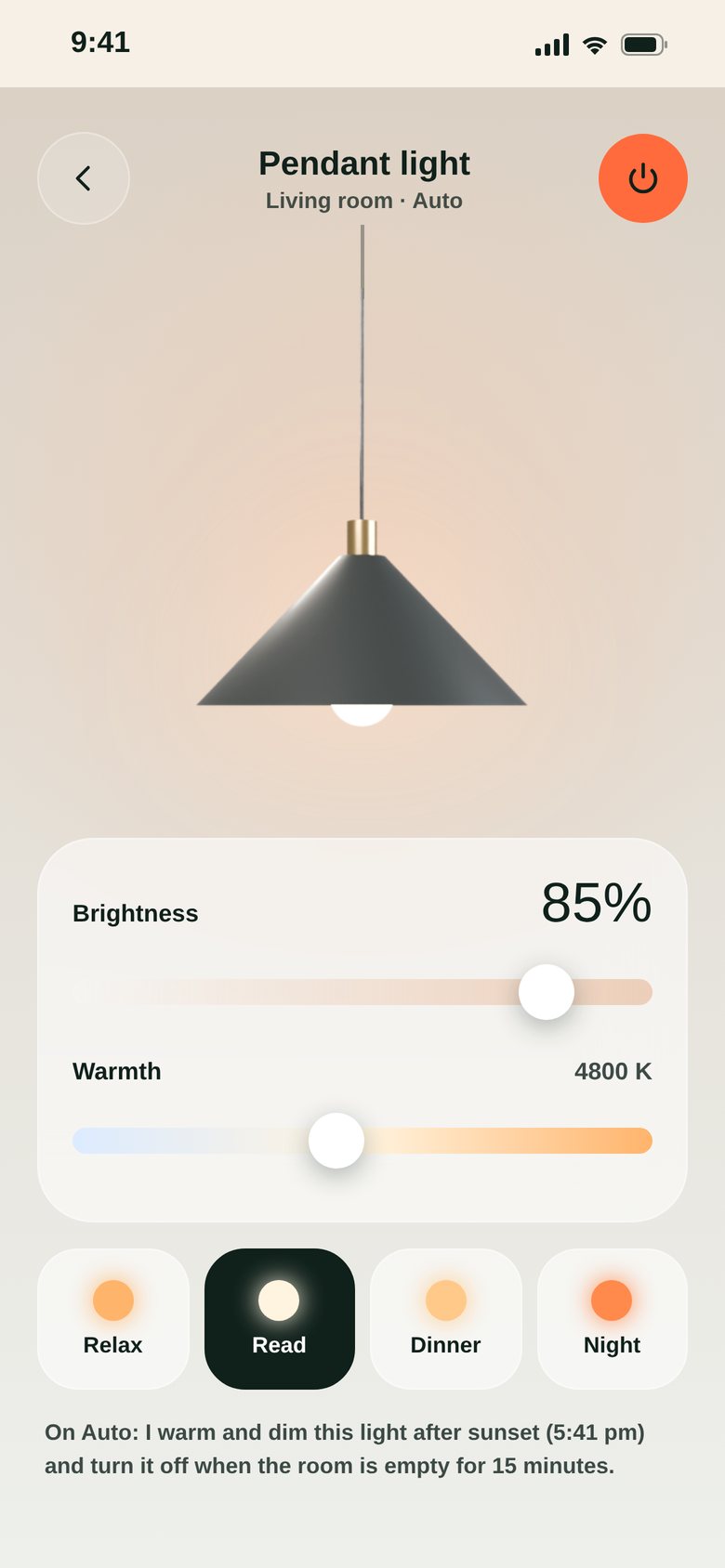
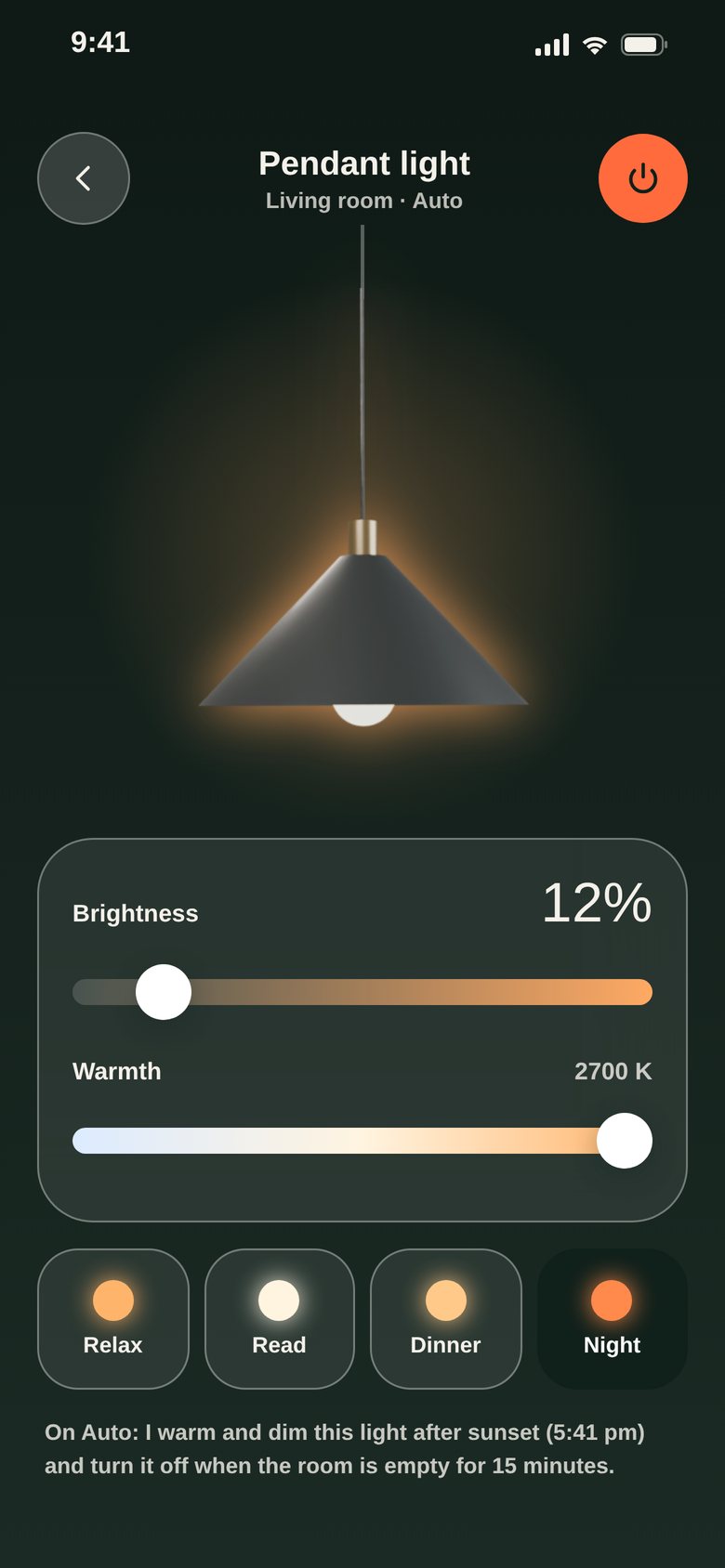
After sunset the home warms and dims the lights on its own. Touch a slider and the room is yours until 11 pm: the home says so in plain words instead of quietly fighting you.
Climate is the biggest lever in a UAE home. The bedroom AC drops to 23° by 10 pm because that’s when the household sleeps deepest, then warms to 24.5° before the alarm.
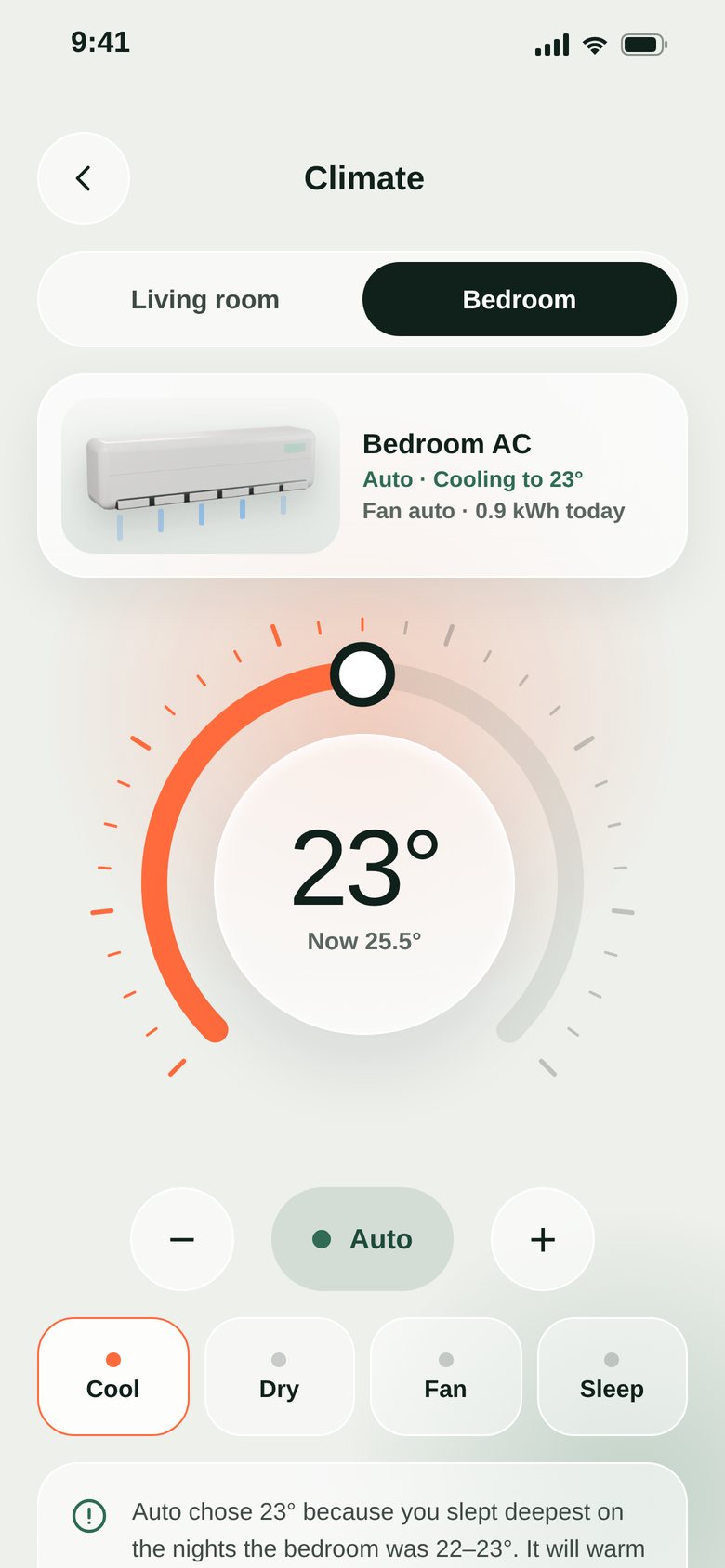
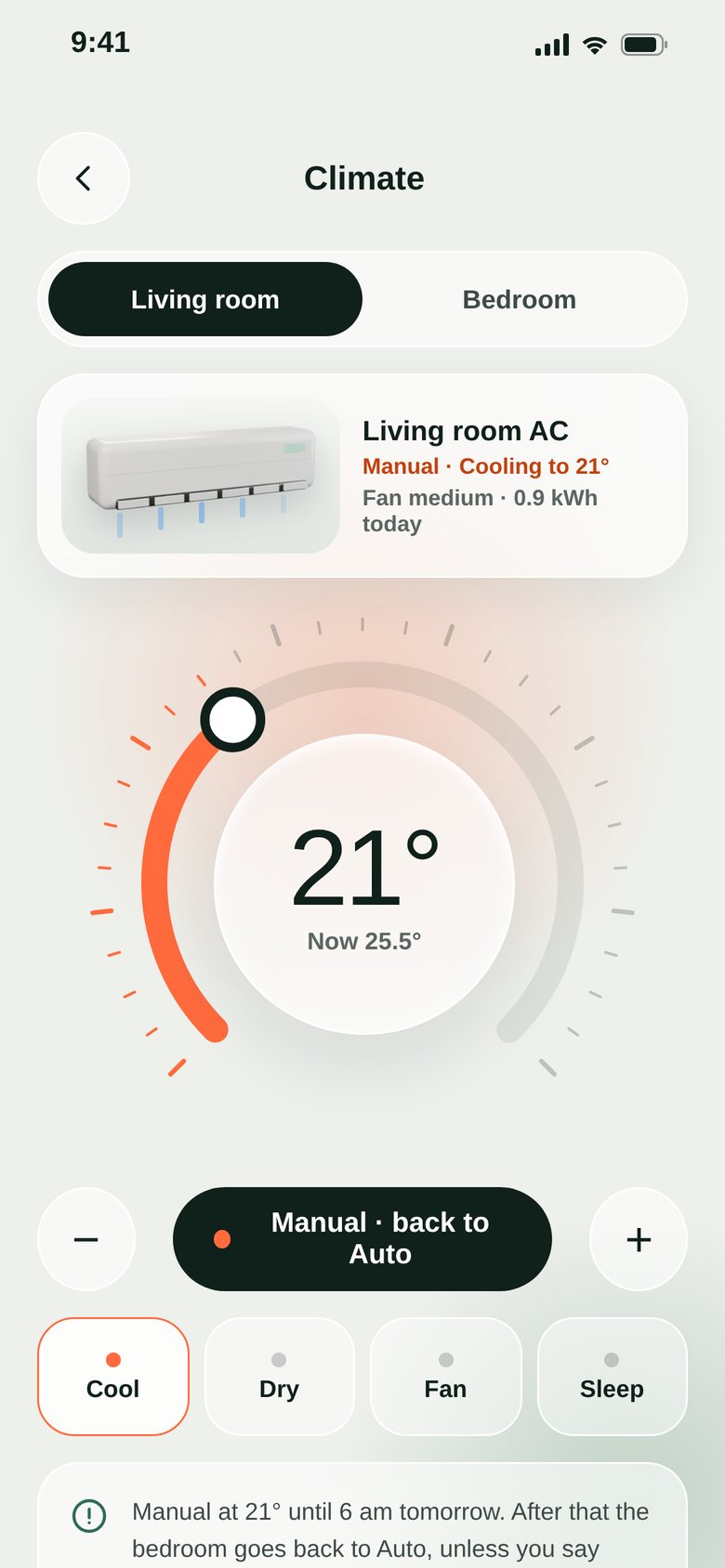
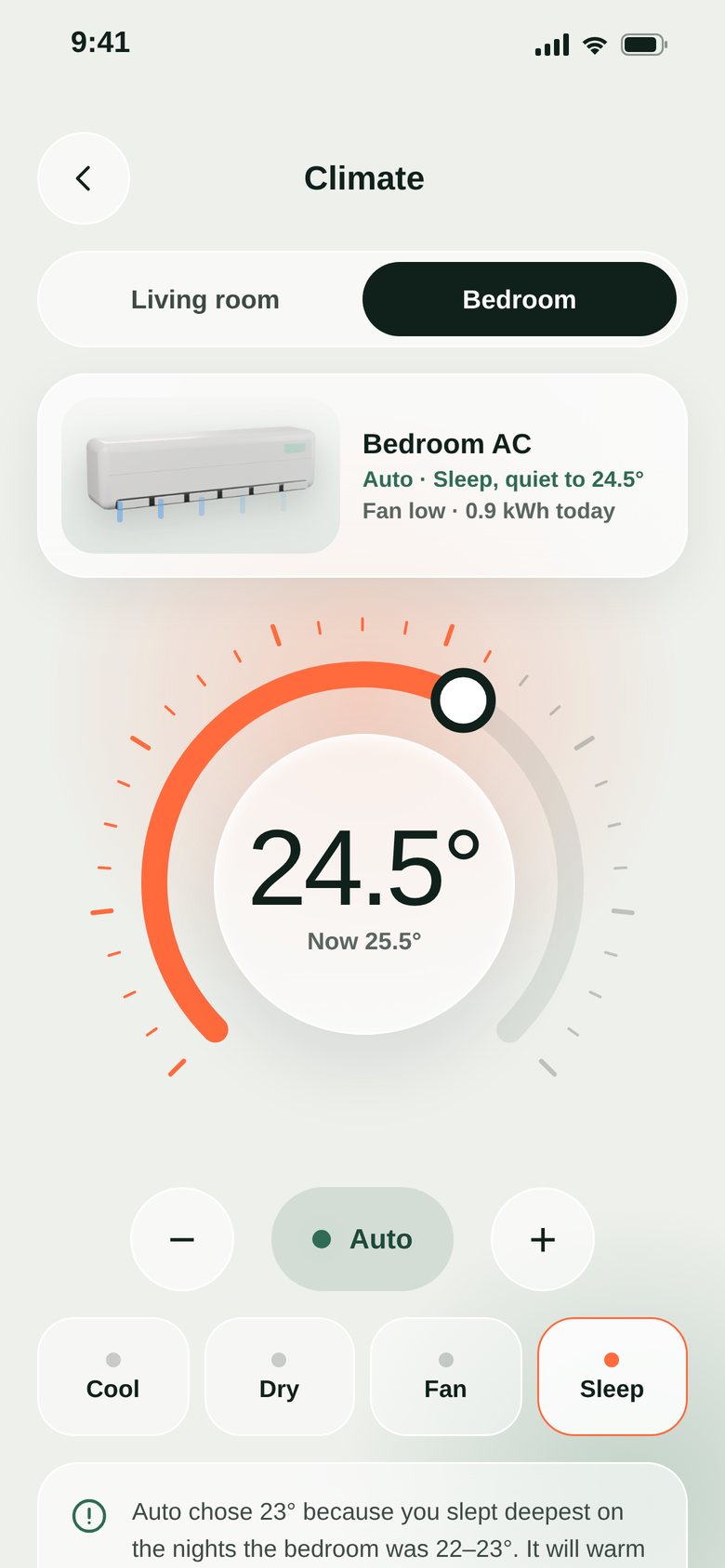
Three questions instead of thirty settings, by voice or by tap, in Arabic or English. By the night the family moves in, the home already knows when they sleep and how cool they like it.
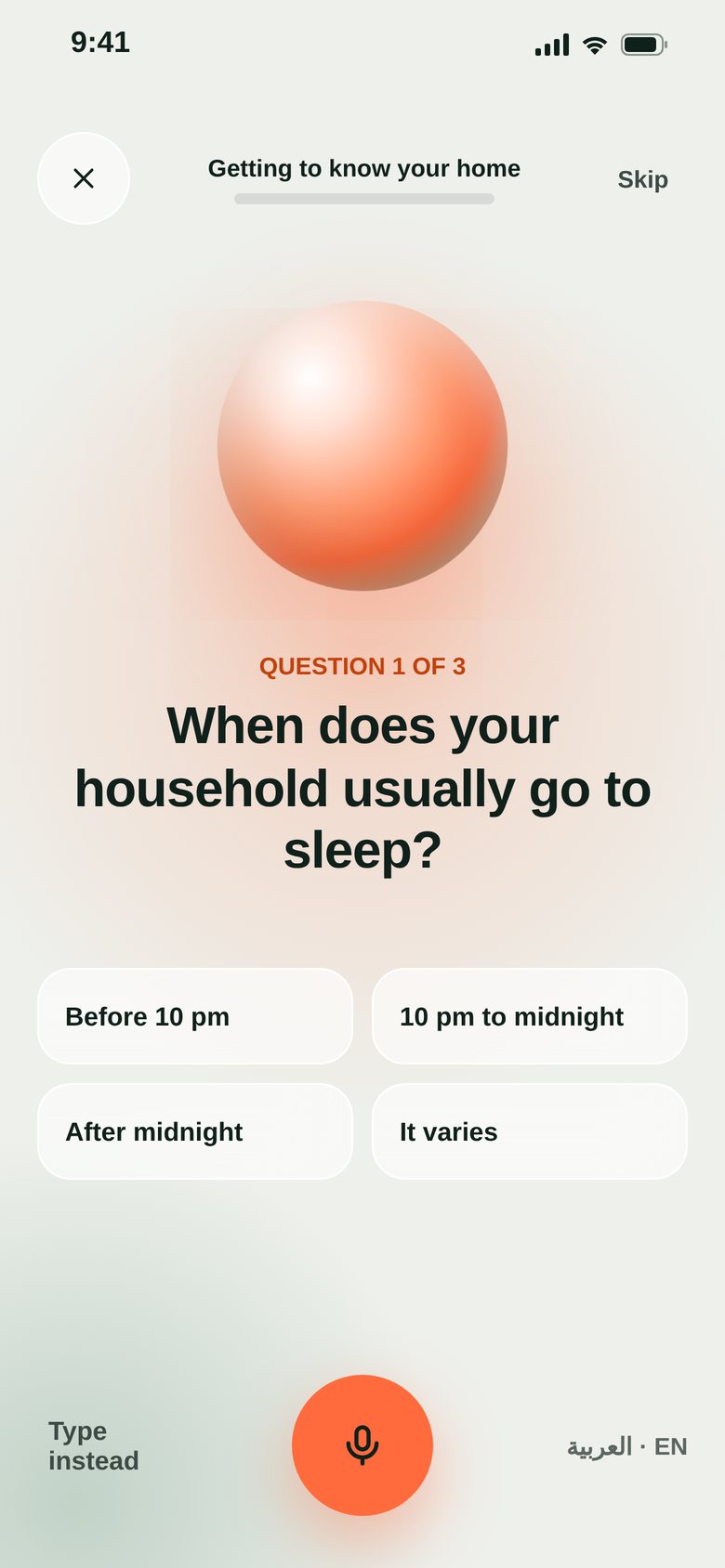
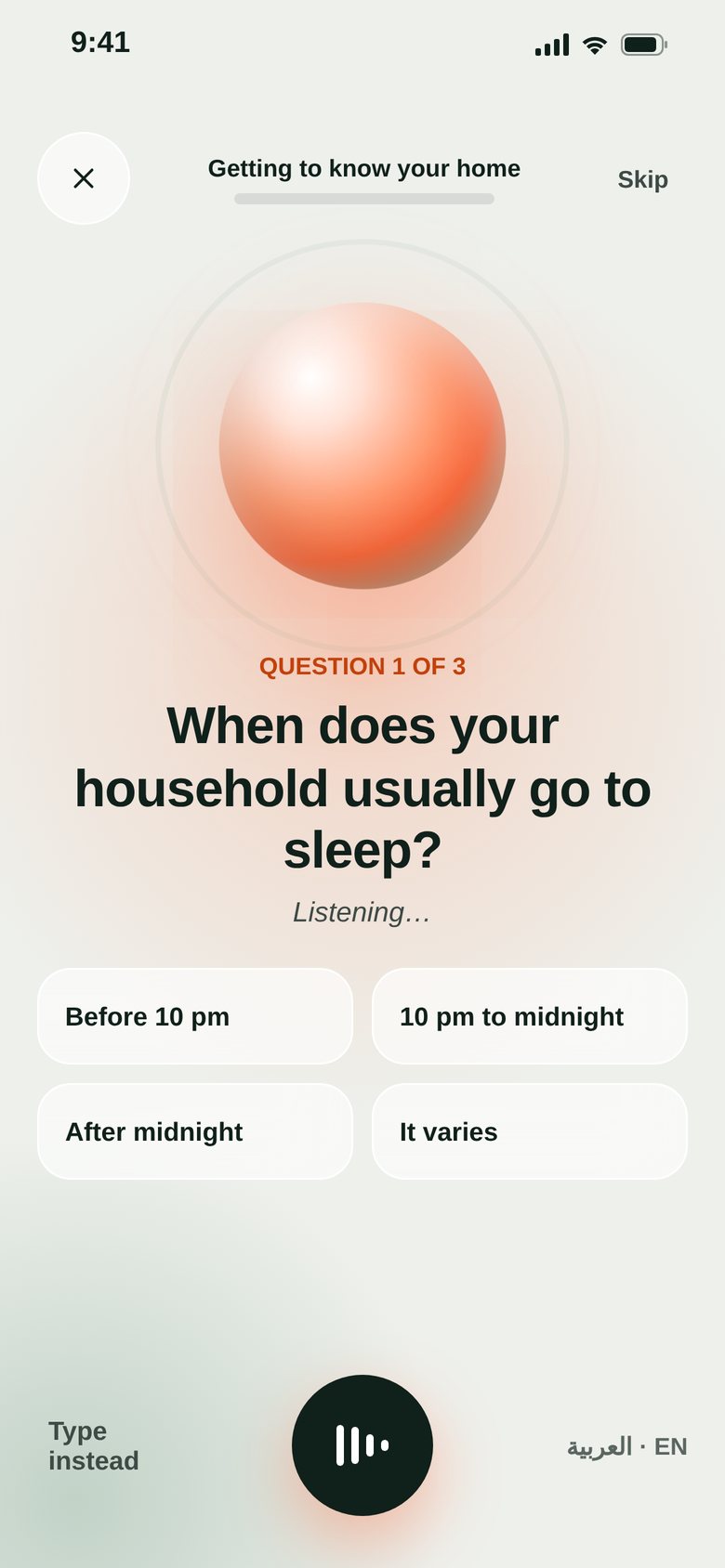
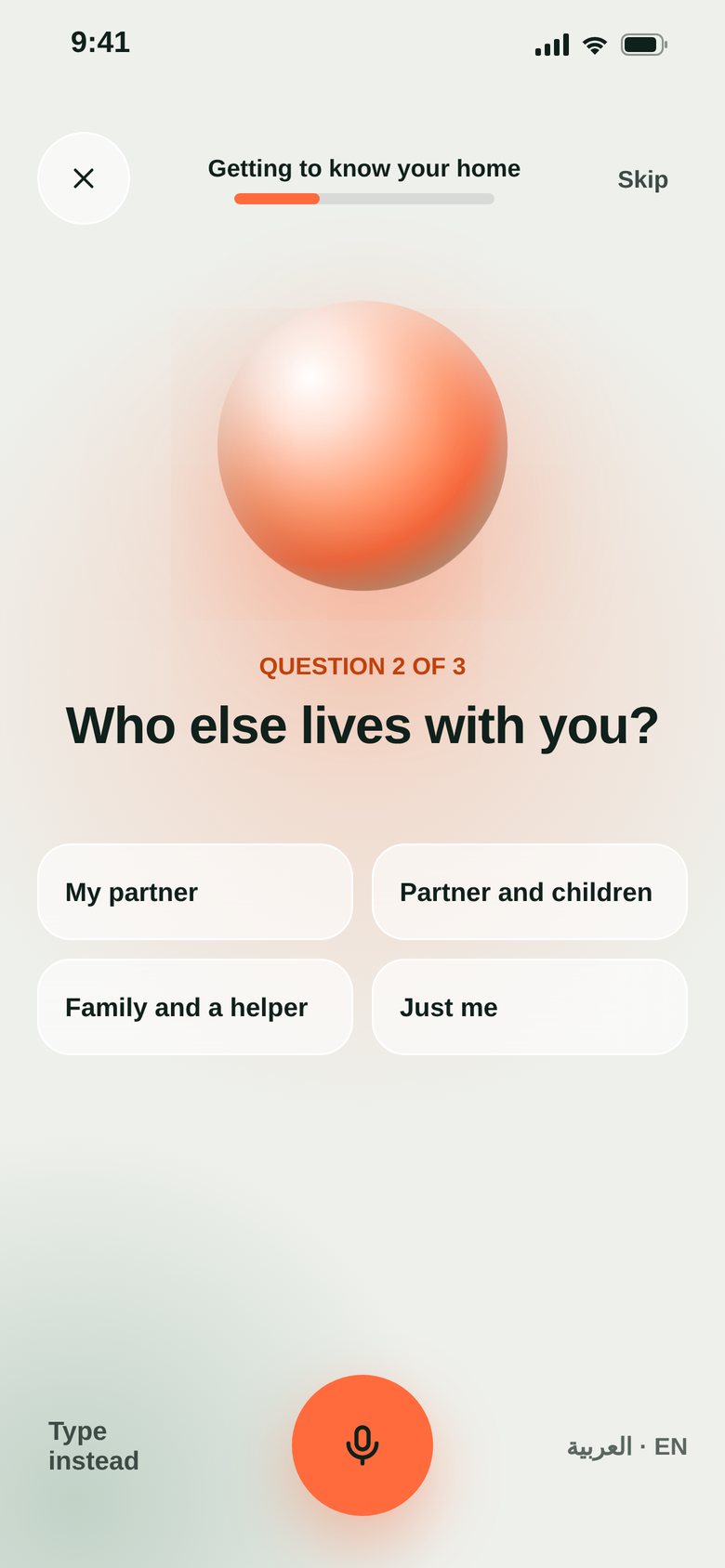
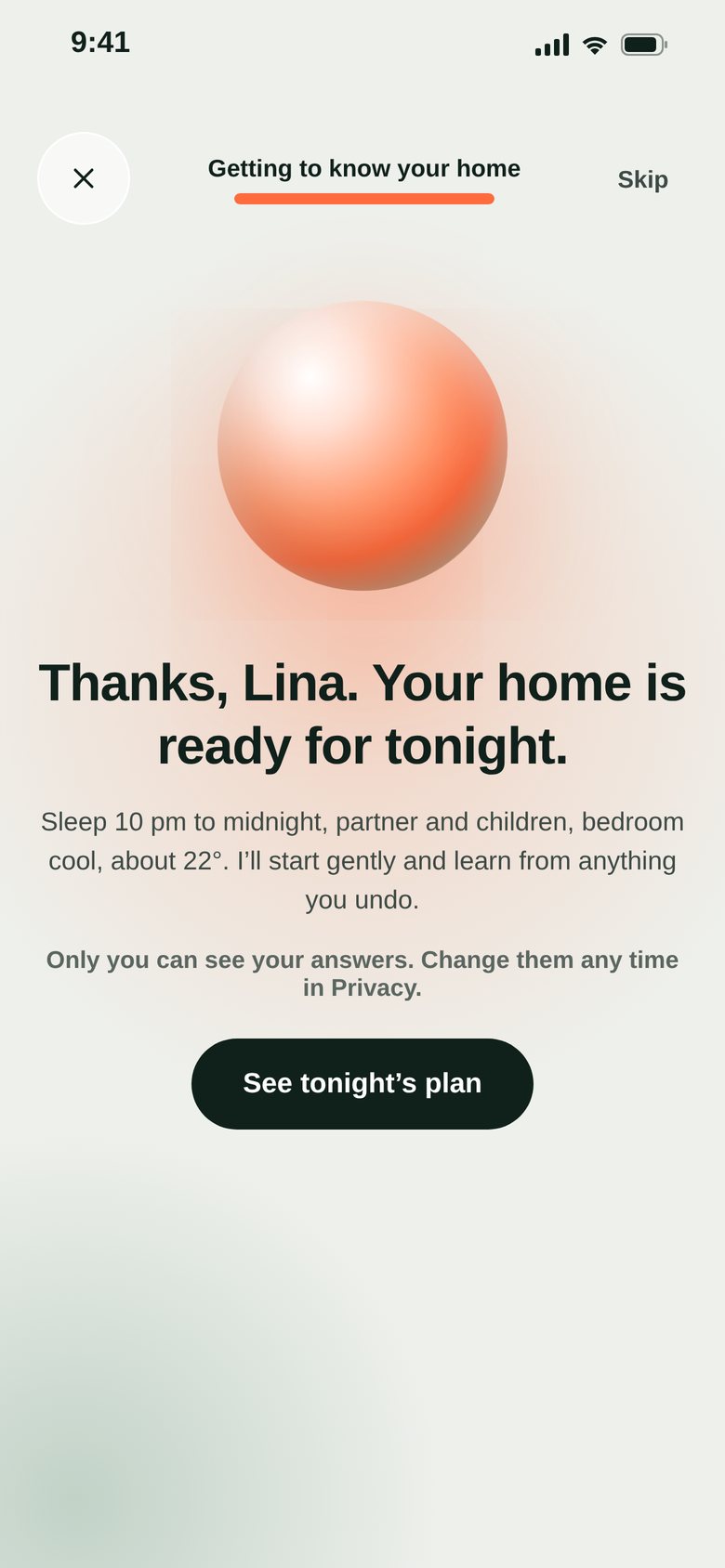
No daily sleep score. Once a week, the home shows what it changed and what seemed to help, and offers one suggestion that Lina can accept or snooze.
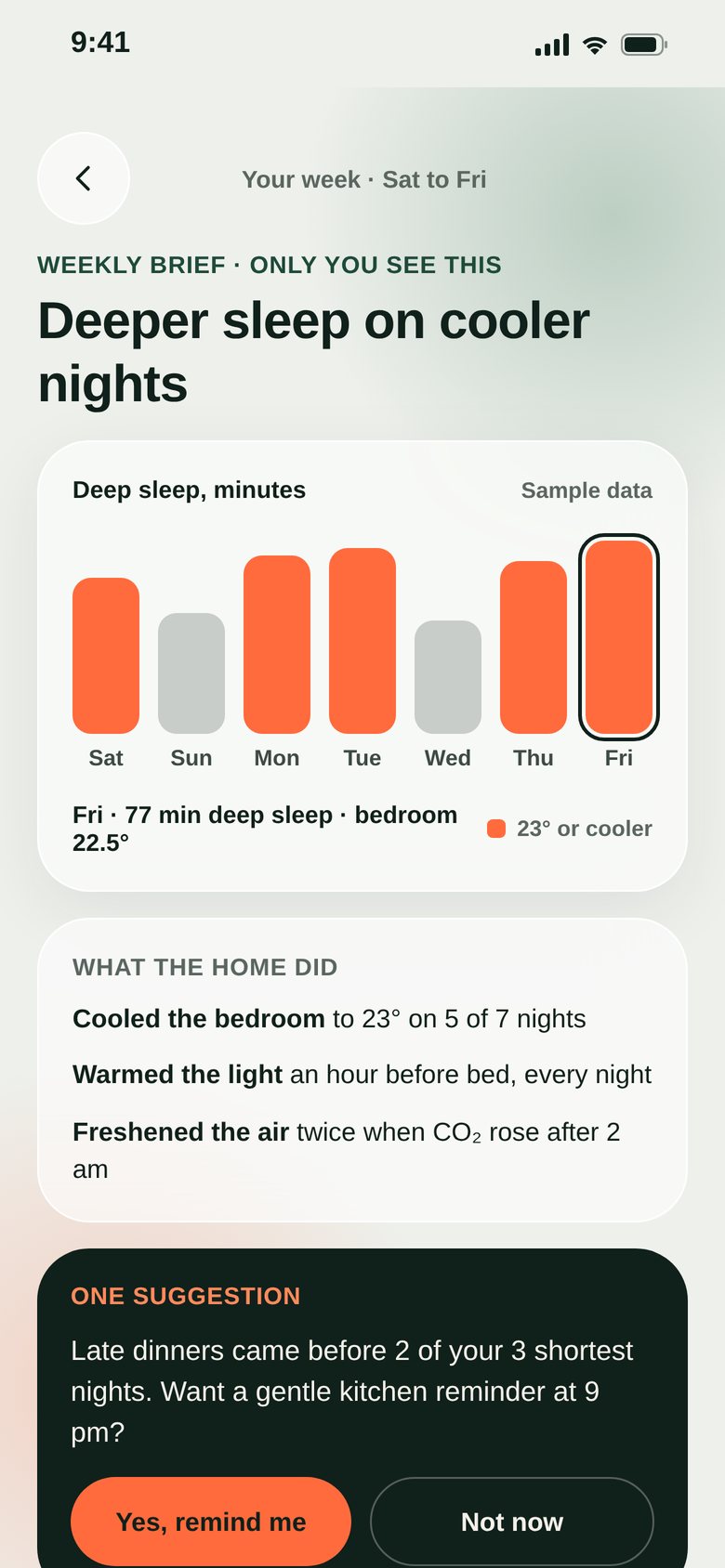
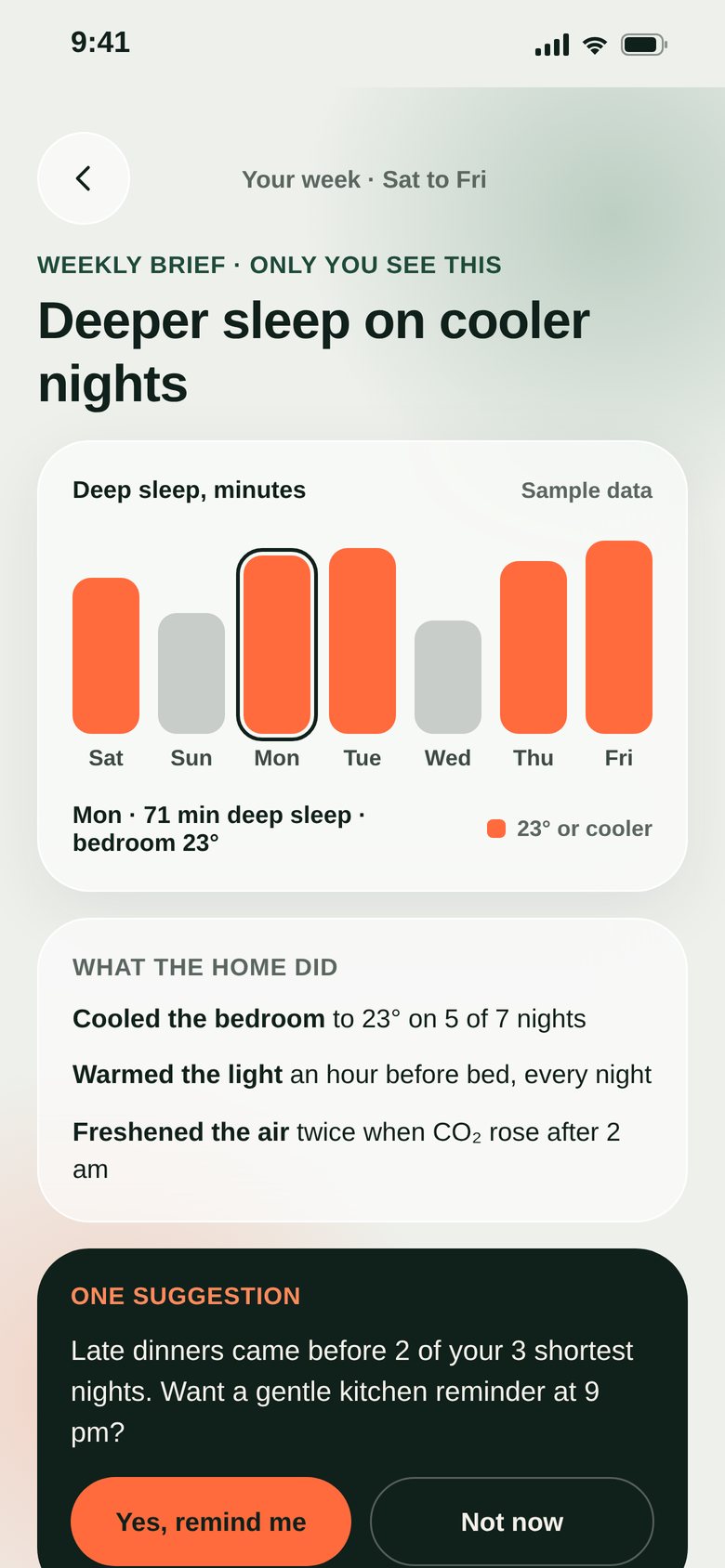
Not everyone will open an app. The tablet by the door is shared and guest-safe, the mirror gives a glanceable brief, and the wall switch always works, even offline. Same agent, same memory, same five states.
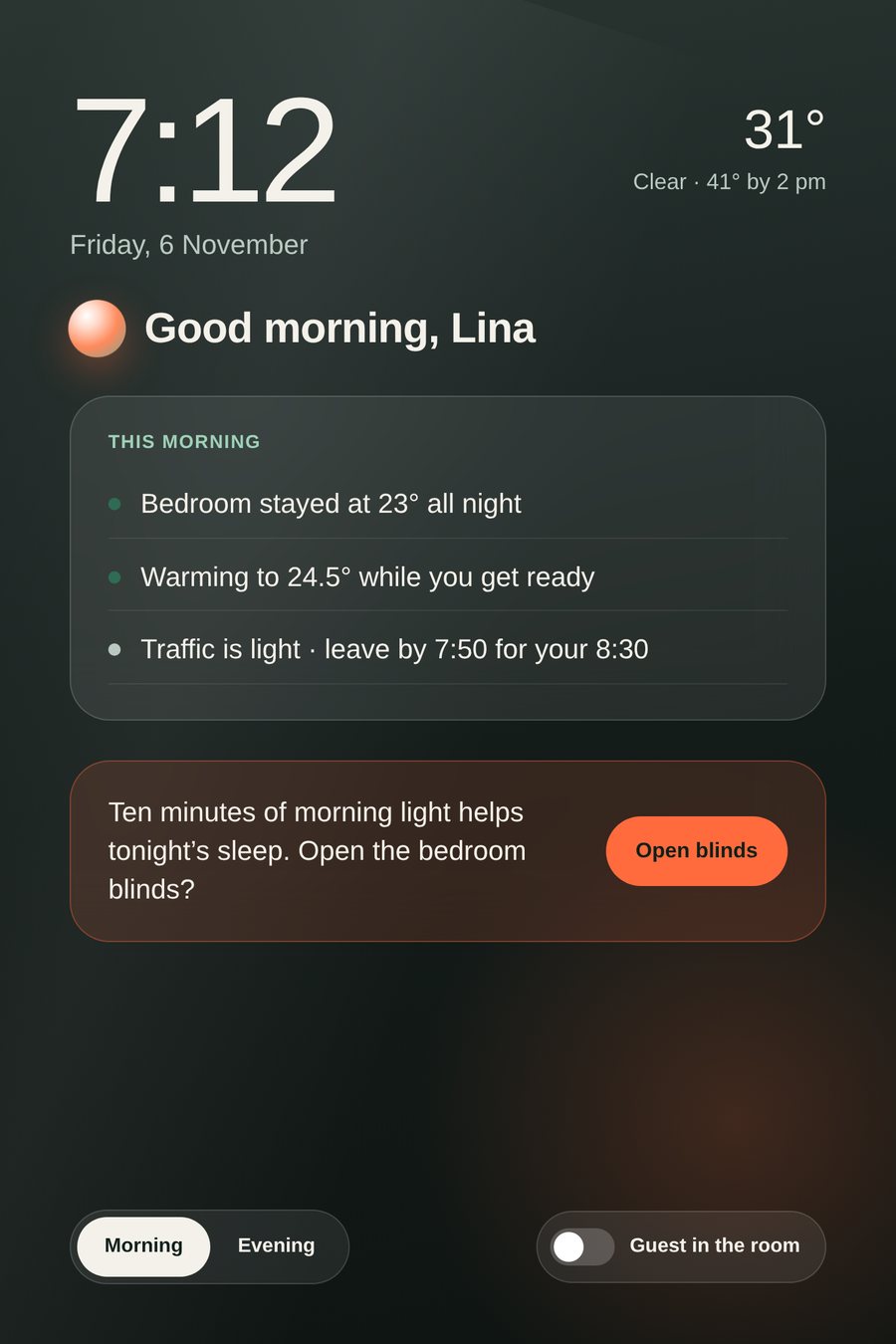
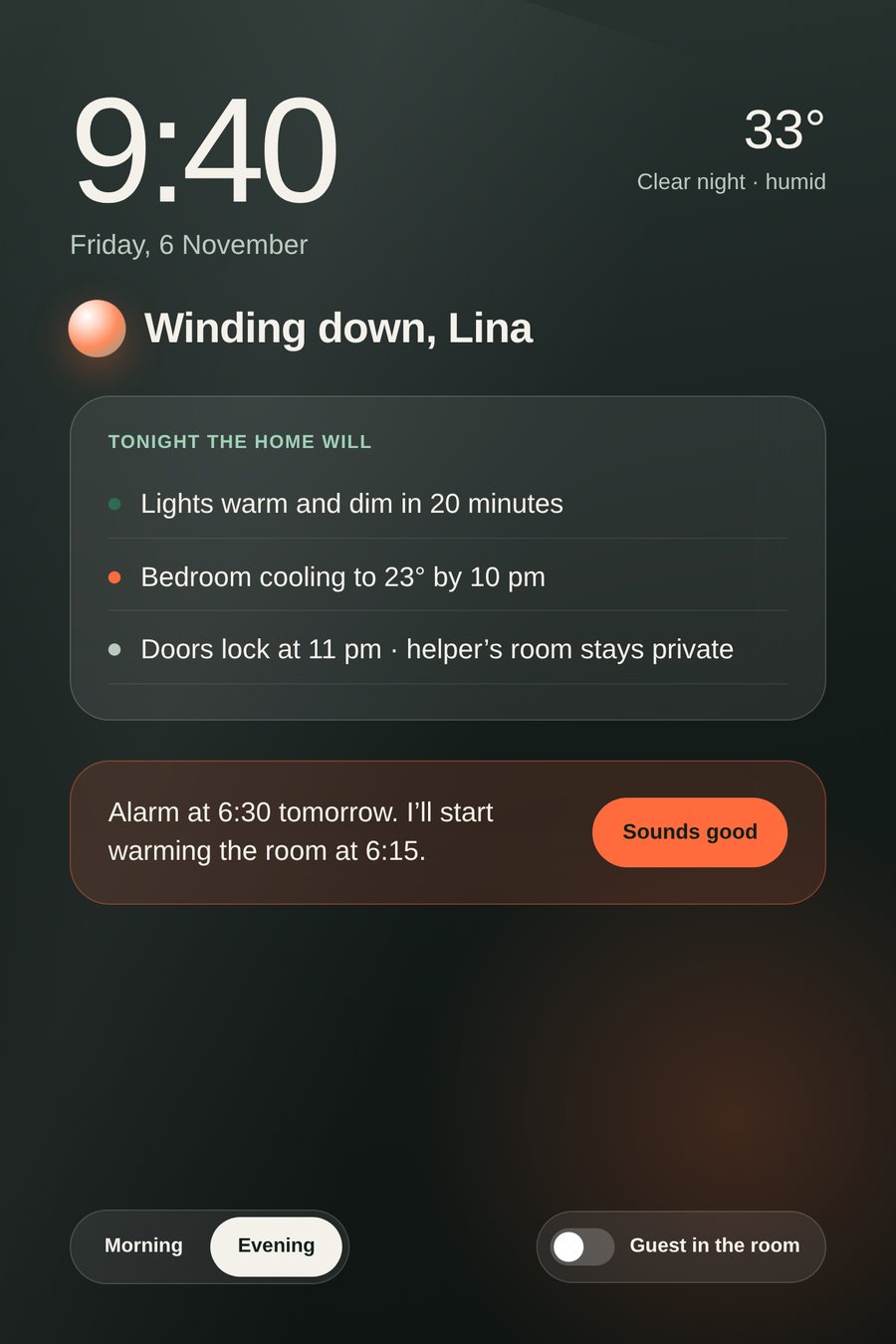
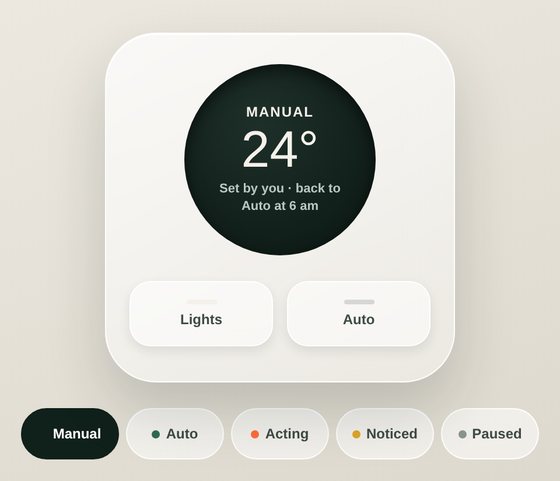
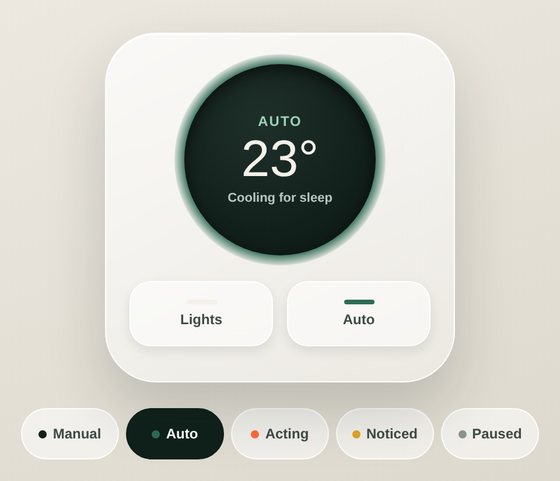
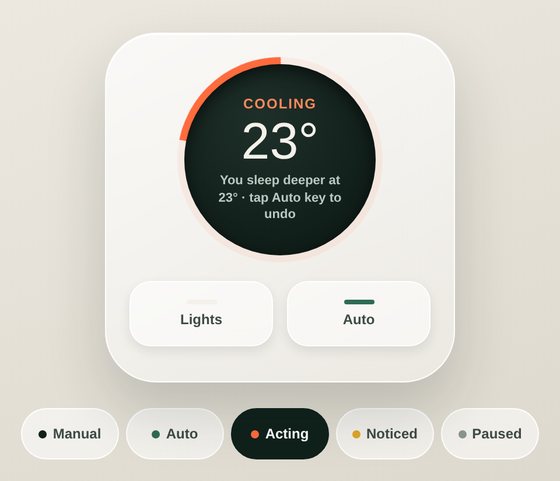
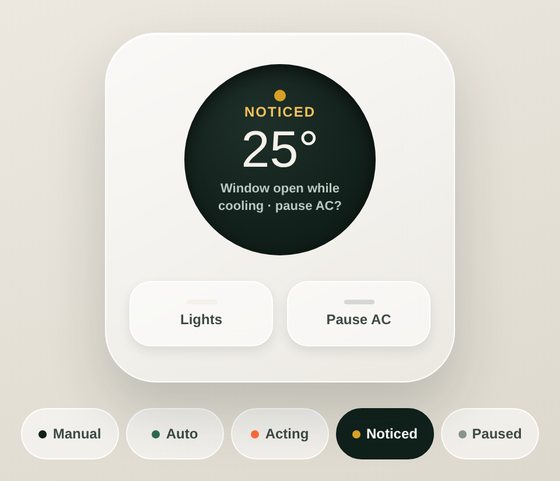
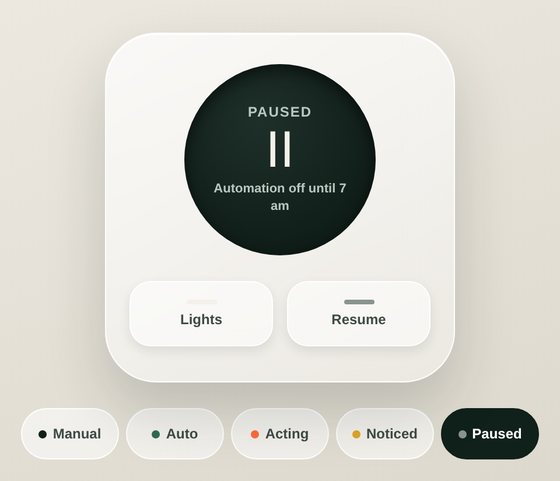
Five states every surface can show, so anyone can tell what a room is doing, why, and how to stop it. A manual action always wins, and every automatic one can be undone for 10 seconds.
A person set this; the home won’t change it
The home is managing this room, calmly
A change is happening now, with the reason and undo
Something it won’t act on alone: it asks
Automation off until a set time; safety still alerts
The wall switch: always works, even offline, and shows the same five states.
Thirty requirements across pre-sales, onboarding, handover and living. Each one gets a score; three kinds of work skip the queue entirely.
Requirements by journey stage and MoSCoW priority
| Stage | Must | Should | Could |
|---|---|---|---|
| Pre-sales | 4 | 1 | 1 |
| Onboarding | 4 | 2 | 0 |
| Handover | 4 | 1 | 1 |
| Living | 8 | 3 | 1 |
Requirements shipped per release
Every Must lands by R2 except wellness, which waits for R3 on purpose. Safety, privacy and reliability items ship in R0.
Before launch
Prove the home is right and fast in 20 lab homes and the Experience Centre.
~12 months in
Tower 1 lives with Sakan: Now, rooms, modes, roles, privacy, switch, mirror, remote.
Next
AI brochure for brokers, the home interview, construction and snagging, profile ready at handover.
Later
Wearable signals, the weekly brief, sleep-zone sensors, a 3D avatar for key moments only.
Later
The same agent in one commercial tower: desks, rooms, air, occupancy only in aggregate.
The agent’s behaviour, memory, explanations and AI quality bar. Product owner, PMs, an AI conversation designer, an AI evaluation lead.
The journey from brochure to living, and the resident NPS. Product owner, PMs, product and UX/UI designers.
Wall switch, mirror, tablet and sensors with hardware engineering and suppliers.
23°Manrope 200–800
Light weights for numbers you read from across a room, heavy weights for labels. Arabic and English, with full right-to-left layouts.
The agent is an orb, not a face: calmer, and it works on a switch as well as a tablet.



A Gulf doorway arch with the home’s presence waiting inside: home and agent in one mark. The open base keeps it from reading as a lock.
Actions the home took that nobody reversed. It rewards being right and being invisible at the same time.
Targets are starting hypotheses for the pilot, reset after the first 90 days of data.
The AI brochure and the avatar demo do the selling; brokers keep the relationship and the close.
Control, safety and privacy come with the unit. A wellness tier comes only once residents tell us what they’d pay for.
Automations kept, latency, overrides, NPS and AI quality, with staged rollouts and holdout tests for every change.
Is a 3D avatar delightful or awkward once the novelty fades, and for whom? It stays opt-in until the lab answers.
How should live-in helpers’ access and privacy work, so their room is theirs and nobody is monitored?
Is it wanted, and how should lights, AC and quiet mode behave around it?